Who Needs AI Visibility Tracking Right Now?
Search visibility is no longer defined only by where your website ranks on Google.
Customers can now ask ChatGPT, Gemini, Claude, Perplexity and AI-powered search experiences to compare products, shortlist providers, explain categories and recommend businesses—often without following the traditional search journey.
For marketing and SEO teams, that creates a second visibility layer:
Does your brand actually make it into the answer?
This does not mean traditional SEO has stopped working. Google explicitly says established SEO best practices continue to apply to its AI search experiences. What has changed is the number of places where brands must now earn visibility.
Ranking a page is one signal. Being mentioned, cited, positioned favourably and recommended by AI systems is another.
And some businesses need to understand that shift much sooner than others.
The fastest way to know whether AI visibility matters to your business
Before looking at individual industries, consider how customers make decisions in your market.
Your need for AI visibility tracking increases significantly when customers:
Research extensively before buying.
Compare several providers or products.
Ask recommendation-based questions.
Depend on expert opinions and third-party validation.
Search for “best,” “top,” “alternative,” “vs,” or “recommended” solutions.
Need to understand a complicated product before purchasing.
Spend considerable time at the top and middle of the funnel.
Can complete much of their research without visiting vendor websites.
There is another important factor: AI systems do not depend exclusively on your website when forming answers.
McKinsey found that a brand's own websites can represent only a small portion of the sources referenced by AI-powered search, with third-party publications, affiliates and user-generated sources contributing substantially to the answer ecosystem.
That means a business can have excellent conventional rankings and still have weak representation in AI-generated recommendations.
1. B2B SaaS and software companies
B2B software is one of the clearest use cases for AI visibility monitoring.
Software buyers naturally ask questions that AI systems are good at answering:
What is the best CRM for a small sales team?
Which project management platforms support enterprise SSO?
What are the best alternatives to [competitor]?
Compare platform A vs platform B.
Which software is best for a company with 100 employees?
These searches happen before a buyer reaches a pricing page or requests a demo.
The problem for SaaS teams is therefore not merely whether their product page ranks. It is whether the company appears in the consideration set AI generates.
What SaaS teams should measure
Track:
Brand mention rate
Non-branded prompt visibility
Average position within recommendations
Competitor share of voice
Domain citations
Product-category coverage
Sentiment and positioning
Prompts where competitors appear but your brand does not
A competitor consistently appearing in “best software for X” recommendations can influence pipeline before conventional attribution ever sees the prospect.
2. Financial services, fintech and insurance
Financial decisions combine high value, high trust and significant research.
Customers rarely choose an insurer, lender, investment platform or financial product from one search. They compare features, fees, eligibility, risk, reputation and expert guidance.
AI assistants make that research significantly easier.
Instead of opening ten articles, a potential customer can ask:
Which business banking platforms are best for an ecommerce company?
or:
Compare these three insurance providers for a family.
The answer itself can become part of the buying process.
For financial brands, visibility is therefore inseparable from authority and source credibility.
What matters most
Monitor whether AI systems:
Mention your brand in relevant categories.
Cite your owned content.
Reference credible third-party sources about you.
Position competitors as safer or stronger alternatives.
Accurately describe products and benefits.
Surface outdated or incorrect information.
This is less about chasing another ranking metric and more about understanding how the market's AI-generated narrative represents your business.
3. Ecommerce and consumer brands
AI-assisted product discovery is becoming particularly important for businesses selling products with meaningful consideration or comparison.
A shopper can move directly from:
I need comfortable shoes for long-distance running
to:
Which three models would you recommend for someone with flat feet under $150?
The journey is moving from keyword → results → product pages toward need → recommendation → shortlist.
That changes what winning visibility looks like.
Retailers and product brands need to understand:
Which products are recommended.
Which competitors appear alongside them.
Which product attributes AI associates with the brand.
Whether trusted sources reinforce those claims.
Which high-intent prompts produce no brand visibility.
This is likely to become increasingly significant as AI shopping and agent-led commerce mature. Bain notes that third-party AI agents are increasingly influencing which retailers and products enter the customer's consideration set.
4. Professional and business services
Legal firms, accounting practices, consultancies, technology providers, commercial contractors and other professional-services businesses often depend on expertise-driven discovery.
Their potential customers ask questions such as:
Who are the leading cybersecurity companies in Chicago?
Which tax consultants specialize in international businesses?
What should I look for in a commercial roofing contractor?
Which firms provide SOC 2 compliance support?
These searches combine location, expertise, reputation and recommendation intent.
That makes professional services particularly sensitive to whether AI understands:
What the company actually does.
Which industries it serves.
Where it operates.
What differentiates it.
Whether external sources validate its expertise.
A business can rank for its own name while remaining almost invisible when prospects ask category-level questions.
That gap is exactly what non-branded AI visibility should reveal.
5. Travel and hospitality
Travel decisions are naturally conversational.
People rarely begin with one precise transactional keyword. They explore:
Where should we travel?
Which hotels suit families?
What destinations are best during a particular month?
Which safari operators have the best reputation?
What should we do during a five-day trip?
AI is extremely well suited to these multi-step discovery journeys.
The commercial risk is straightforward: a hotel, destination, tour company or travel provider may never receive consideration if it does not appear in the initial AI-generated shortlist.
Important visibility signals
Travel brands should monitor:
Destination and category prompts
Recommendation frequency
Competitor mentions
Brand sentiment
Location-based visibility
Third-party citations
Experience and amenity descriptions
Traditional rankings remain useful, but AI visibility reveals whether the brand is actually entering the conversation.
6. Healthcare, wellness and high-trust services
Health-related discovery requires particular care because accuracy and trust matter enormously.
People often research symptoms, treatments, providers and services before contacting a healthcare organization.
For legitimate healthcare and wellness businesses, the primary visibility question is not simply:
“Are we mentioned?”
It is:
“Are we being represented accurately, appropriately and from trustworthy evidence?”
This makes citation monitoring, sentiment, entity accuracy and content quality especially important.
Businesses in high-trust categories should prioritize correctness and authoritative information over attempts to artificially manufacture AI mentions.
7. Companies competing in crowded categories
Industry alone does not determine urgency.
Sometimes the biggest signal is simply competitive density.
Imagine ten companies selling broadly comparable solutions.
If four repeatedly appear across ChatGPT, Gemini, Claude and Perplexity while six rarely do, AI discovery can gradually reinforce the visibility advantage of the first group.
This applies to:
SaaS
Ecommerce
Fintech
Education
Business services
Real estate
Technology
Recruitment
Hospitality
Consumer services
The more interchangeable providers appear to a customer, the more valuable recommendation visibility becomes.
Who does not need to prioritize AI visibility yet?
Not every business needs a dedicated AI visibility program today.
It may be a lower priority when:
Almost all revenue comes from referrals or existing contracts.
Customers do little online research.
Search contributes virtually nothing to acquisition.
The business operates in an extremely narrow offline market.
There is not enough content or digital presence to optimize yet.
Basic technical SEO and website quality still require major work.
AI visibility should not become a distraction from fundamentals.
Google's own guidance reinforces this point: there is no secret markup or special shortcut required to appear in its generative AI experiences. Strong technical accessibility, useful content and established SEO practices continue to matter.
The difference is that brands now need a way to measure what happens after those fundamentals are in place.
Five signals that your business should start measuring AI visibility now
1. Competitors appear when you don't
Ask commercially meaningful questions about your category across several AI platforms.
If competing brands repeatedly appear and yours does not, you already have a measurable visibility gap.
2. Your customers research before contacting sales
The longer the research journey, the more opportunities AI has to shape the shortlist.
3. Organic search is an important acquisition channel
If SEO contributes meaningfully to pipeline or revenue, changes in discovery behaviour deserve measurement alongside rankings and traffic.
4. Your category depends on trust
AI citations, descriptions and source selection can materially influence how credible a brand appears.
5. Your team is investing heavily in content
Content should not be evaluated only by rankings and traffic.
You also need to know whether it contributes to AI mentions, citations, category visibility and competitive positioning.
What should brands do next?
The answer is not to abandon SEO and rename everything GEO.
A more useful approach is to expand the measurement model.
Establish an AI visibility baseline
Identify the questions customers ask before choosing a company like yours.
Track those prompts across relevant AI platforms and establish:
Mention rate
Citation rate
Visibility
Share of voice
Sentiment
Competitor performance
Separate branded from non-branded discovery
A brand appearing when users specifically mention its name tells you very little about category discovery.
The more important question is:
Does the business appear when the customer doesn't already know it exists?
Identify competitive gaps
Look for prompts where competitors appear consistently and your brand is missing.
These gaps can reveal:
Missing content
Weak category association
Limited authority
Poor third-party coverage
Technical discoverability problems
Check technical AI readiness
Make sure important pages are accessible, indexable, structured clearly and understandable by machines.
That includes fundamentals such as:
Crawl accessibility
Sitemap coverage
Canonical consistency
Structured data
Useful page titles and descriptions
Clear content hierarchy
Turn measurement into action
Visibility monitoring without execution becomes another dashboard.
The goal should be to move from:
What happened?
to:
What should we improve next?
AI visibility is becoming part of search performance
The strongest businesses will not choose between SEO and AI visibility.
They will measure both.
Traditional search tells you how your pages perform within search engines.
AI visibility tells you how your brand is represented inside generated answers and recommendations.
Google's introduction of dedicated generative-AI visibility reporting in Search Console in 2026 is another indication that this layer of search performance is becoming measurable rather than theoretical.
And that is ultimately the question businesses need to answer:
When a potential customer asks AI about your category, does your brand make the shortlist?
Where Intelexus fits
Intelexus helps teams answer that question with evidence.
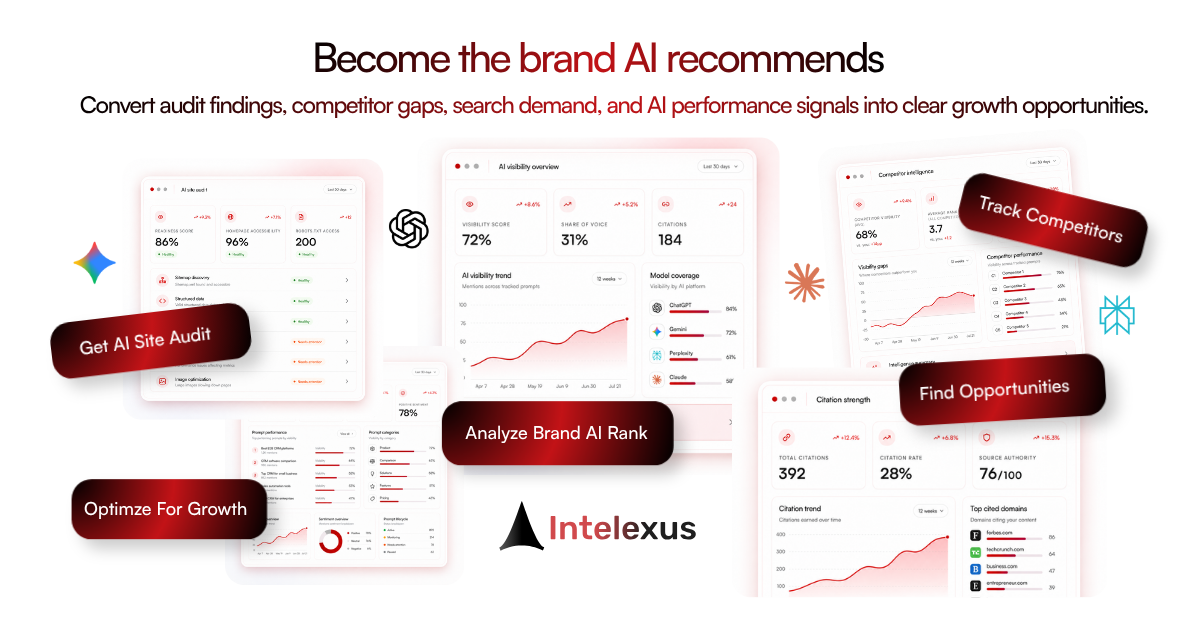
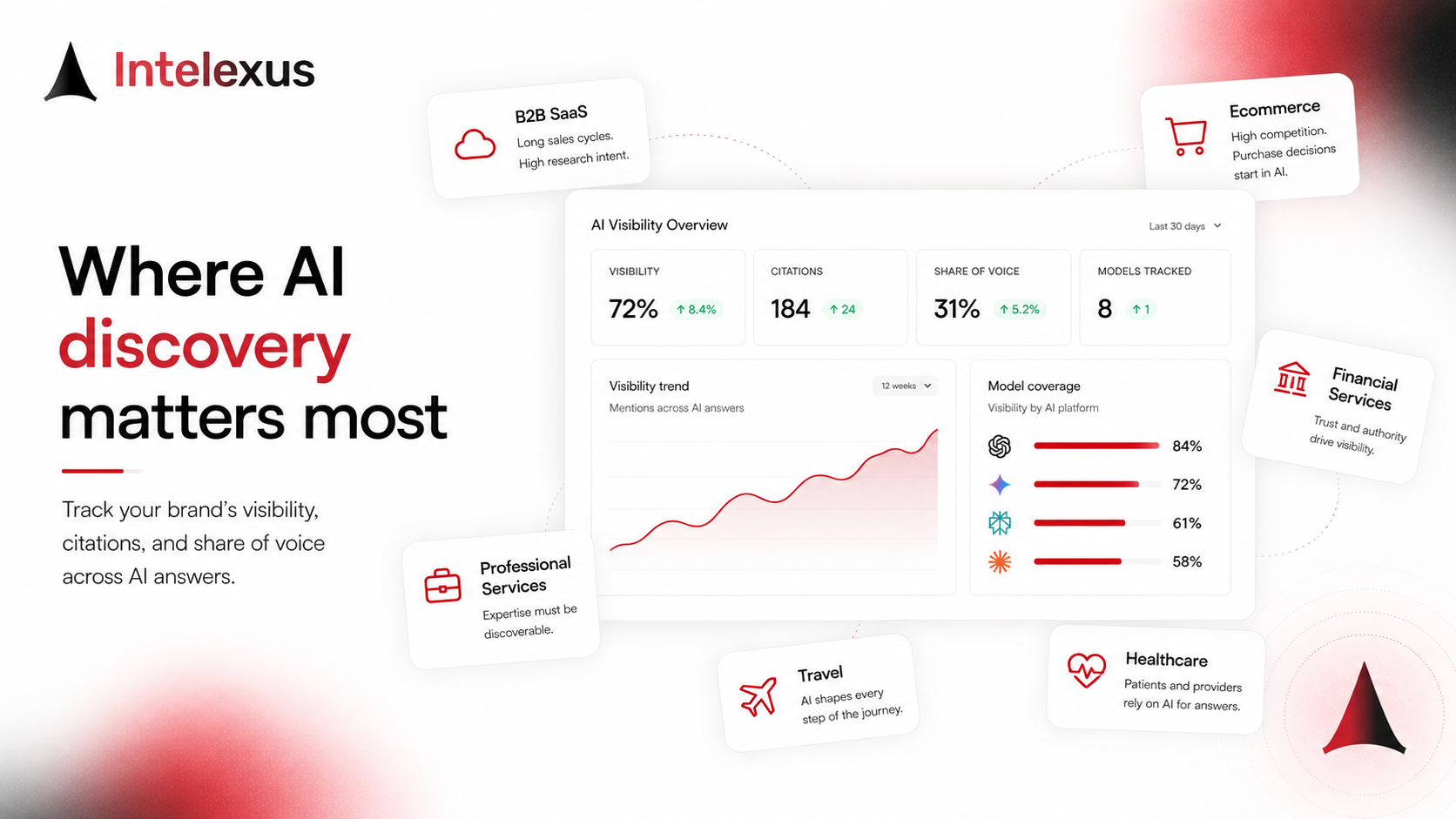
Track how your brand performs across ChatGPT, Claude, Gemini and Perplexity, including mentions, citations, sentiment, share of voice and competitive visibility. Intelexus also connects those signals to site readiness and prioritized opportunities so teams can understand not only where visibility is weak, but what to work on next.
Become the brand AI recommends.