 By
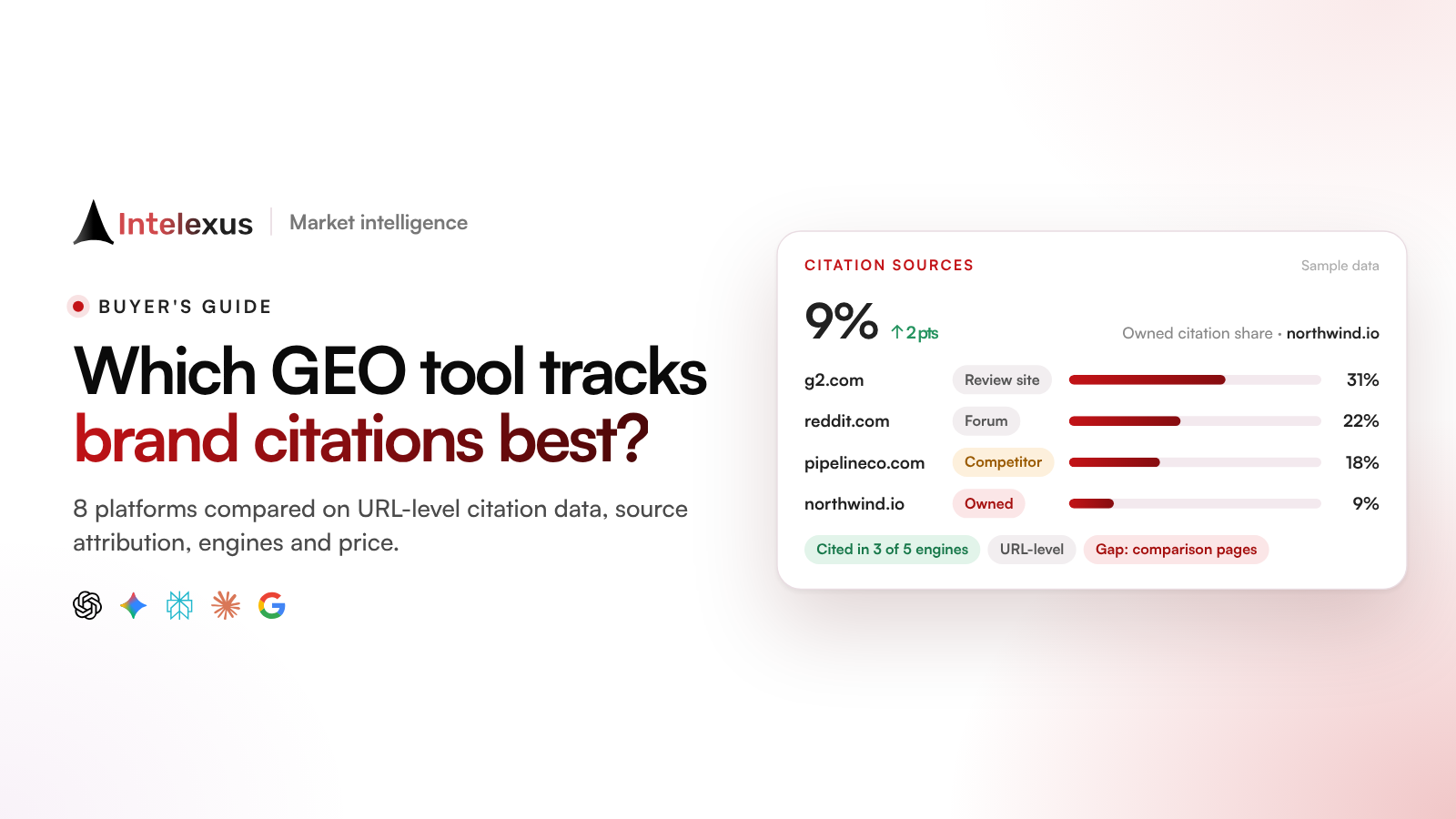
A mention tells you AI noticed you. A citation tells you why.
The best GEO tool for tracking brand citations shows you the exact URLs AI engines cite, labels each source by type, shows which competitor pages hold the spots you want, and turns those gaps into a ranked list of fixes. Seeing citations is only half the job; the risk is that a competitor keeps the answer while you watch a dashboard. On those tests, our picks for 2026 are:
Best overall for acting on citation gaps: Intelexus, from $49/month. Citations sit next to the buyer conversations and search demand behind them, and the gaps come ranked as actions.
Deepest URL-level citation analytics: Promptwatch or Profound.
Lowest-cost citation monitoring: Otterly.AI, from $29/month.
Teams already paying for Semrush: the Semrush AI Visibility Toolkit, at $99/month per domain.
Disclosure: Intelexus publishes this guide and is one of the eight tools compared. We describe each competitor from its own documentation and independent reviews, link every claim, and say where a competitor is stronger than us. Prices were checked in October 2026; confirm them before you buy.
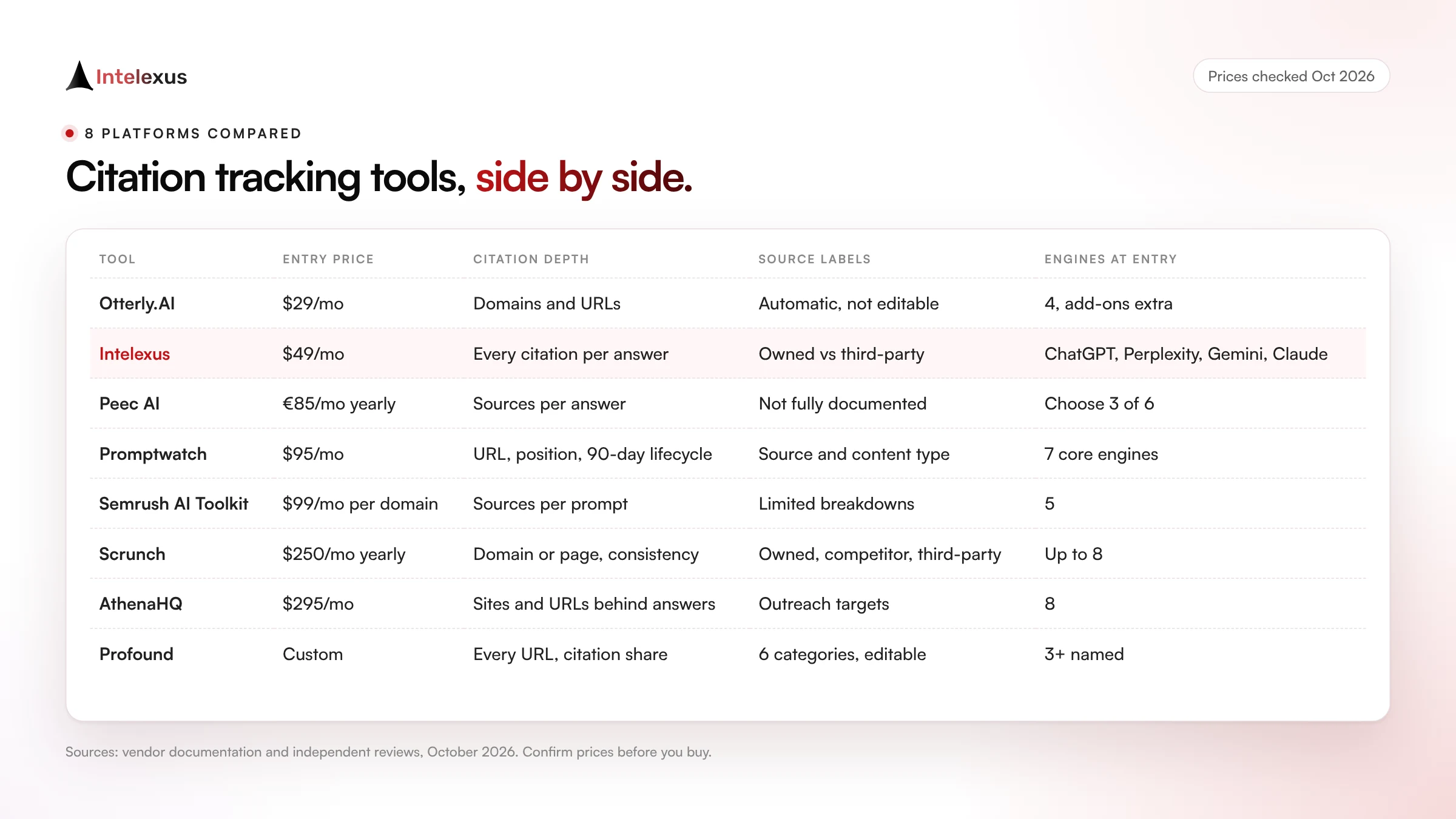
Mentions, citations and source attribution: what each term means
These three terms get used interchangeably, but they measure different things, and tools differ most in how they handle the third.
Brand mention: the AI names your brand in the text of its answer. It tells you whether you are recommended.
Citation: the AI links a source page next to its answer. It tells you which pages the engine trusted to build that answer.
Owned citation: a citation that points to a page on your own domain. It is the clearest sign your content, not someone else's, shaped the answer.
Source attribution: classifying every cited page by who owns it (you, a competitor, a review site, a news outlet, Reddit, a government body) so you can see which kinds of sources drive answers in your category.
The practical difference: mention tracking tells you whether you appear; citation tracking with source attribution tells you why, and which pages you need to create, improve or get featured on to change the answer.
One caution: AI answers are not stable. The same prompt can return different sources on different days and in different countries, so any tool should show you trends across repeated runs, not a single snapshot.
What to check before you choose
Use these seven questions on every demo or trial. They separate tools that genuinely attribute sources from tools that only count mentions.
URL or domain level? Domain counts tell you "reddit.com is cited a lot." URL-level data tells you which thread, which review page, which competitor blog post. You need URLs to act.
How are sources classified? Look for owned, competitor and third-party labels at minimum. Check whether you can correct a wrong label; some tools assign categories automatically and lock them.
How is "owned" decided? Ask whether a citation counts as yours only when it resolves to your domain or subdomain, or whether a mention of your name on another site also counts. Loose rules inflate your numbers.
Which engines are in the entry price? Several tools let you pick three engines, or charge extra for Gemini, Google AI Mode or Claude. Price the plan with the engines your buyers actually use.
Can you see competitor citation share? You want to know which competitor pages win the source slots on the prompts you care about, not just your own totals.
Can you see the raw answers? Every score should trace back to the captured answer and its citations, with a date and country. If you can't open the evidence, you can't verify the trend.
What happens after the data? Citation gaps are only useful if they turn into a to-do list: pages to update, sites to pitch, threads to join. Check whether the tool ranks those actions or leaves that to you.
The 8 platforms compared
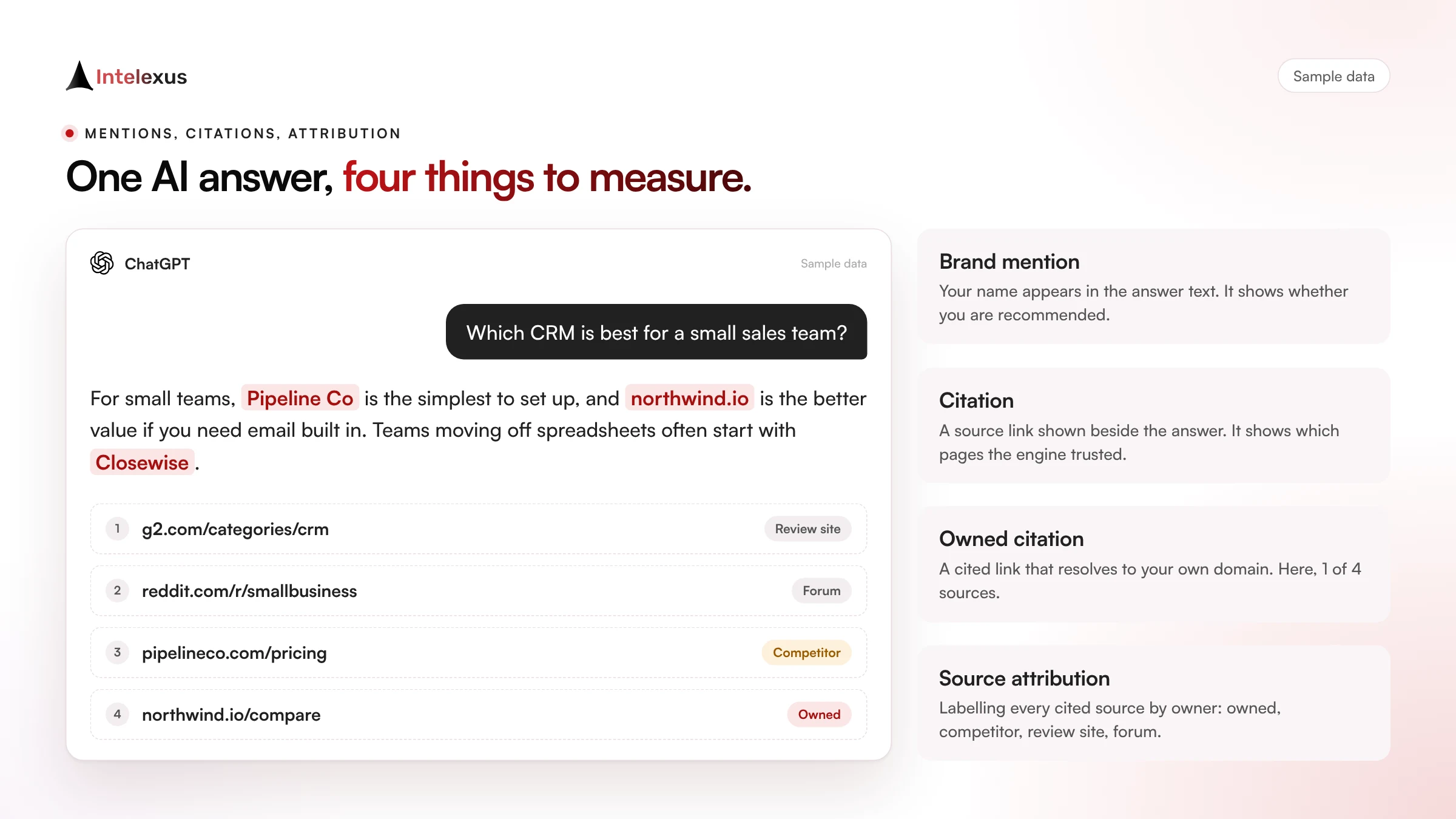
Intelexus first, then sorted by entry price. "Citation depth" describes what each tool documents publicly about its citation views; confirm the details in a trial.
Tool | Entry price (Oct 2026) | Citation depth | Source attribution | Engines at entry price | Best for |
|---|---|---|---|---|---|
$49/mo (Growth) | Every citation captured per answer, owned citation rate, source domains across your market | Owned vs third-party, counted only when the cited URL resolves to your domain; competitor share of voice | ChatGPT, Perplexity, Gemini (Claude in a separate enriched view) | Teams that want citations tied to buyer conversations and search data | |
$29/mo (15 prompts) | Cited domains and URLs by engine and prompt | Auto categories (news, government, competitor, blogs); labels can't be edited | ChatGPT, Google AI Overviews, Perplexity, Copilot; Gemini, AI Mode and Claude are paid add-ons | Small teams starting out | |
€85/mo billed yearly (50 prompts) | Separates mentions from citations; shows cited sources such as G2, Reddit and news | Not fully documented publicly | Choose 3 of 6 | Analytics-focused teams with unlimited seats | |
$95/mo (50 prompts) | Every cited URL with position, domain rank, 90-day citation lifecycle | Source type and content type (listicle, review, comparison); Reddit and YouTube views | 7 core engines | Deep URL-level citation analysis | |
$99/mo per domain (50 prompts) | Cited sources per prompt | Limited domain and model breakdowns | ChatGPT, Perplexity, Gemini, Google AI Mode, Copilot | Teams already on Semrush | |
$250/mo billed yearly (350 prompts) | Citations by domain or page, citation consistency, Influence Score | Owned, competitor, third-party | Up to 8, varies by plan | Mid-market teams tracking many prompts | |
$295/mo (3,600 credits) | Maps the sites and URLs that drive answers; Citation Engine is Enterprise-only | Outreach targets via Action Center | 8, including Claude and Grok | Broad engine coverage | |
Custom (brands); about $399/mo per client for agencies | Every cited URL, citation share by platform, topic and prompt | Owned, competitor, earned media, PR wire, social, institution; editable | ChatGPT, Perplexity, Google AI Overviews and others | Enterprise brands with a sales-led budget |
Platform by platform
1. Intelexus
Intelexus captures every citation in every answer it records across ChatGPT, Perplexity and Gemini, then reports your owned citation rate alongside mention rate and share of voice against the competitors you approve. A citation only counts as yours when the cited URL resolves to your own domain or subdomain, so a mention of your name on someone else's page never inflates the number. Its visibility score uses a published formula: 60% mention rate, 25% owned citation rate, 15% position.
What puts it first is what sits next to the citation data. Reddit and X buyer conversations link back to the original threads, Search Console and GA4 show the demand behind each prompt, and the Opportunity Engine ranks every gap into an action list with the evidence attached. Most tools here stop at showing you who got cited; Intelexus tells you which page to fix, which site to get featured on and which thread to join first.
Best for: growth and marketing teams that want to know why AI cites competitors and what to do next, without an enterprise contract.
Watch out for: it tracks three core engines today (ChatGPT, Perplexity, Gemini, Google Overview/AI mode with Claude in a separate enriched view), so check that the engines your buyers use are covered.
2. Otterly.AI
Otterly's AI Search Analytics lists the domains and URLs each engine cites for your tracked prompts, with counts by engine and prompt. A Domain Citations view groups sources into categories such as news, government and competitor sites.
Best for: small teams that want citation monitoring for the lowest price in this list.
Watch out for: 15 prompts on Lite; Gemini, Google AI Mode and Claude cost extra; source categories are assigned automatically and can't be edited.
3. Peec AI
Peec separates brand mentions from citations and shows which sources, such as G2 listings, Reddit threads and news articles, the models pull from. All plans include unlimited seats and daily tracking.
Best for: analytics-focused teams that want clean monitoring and many users.
Watch out for: you choose 3 of 6 engines per plan, extra engines are add-ons, and the 50-prompt Starter cap fills quickly. Independent reviews don't fully document how it classifies sources, so test that.
4. Promptwatch
Promptwatch has the most detailed public documentation of citation analytics in this list. Each citation records the URL, domain, its position in the source list, source type, content type and domain rank. A Citation Trends view shows when a page was first cited, when it peaked and how fast it decayed over 90 days, and dedicated Reddit and YouTube views cover social sources.
Best for: SEO and content teams that want to study exactly which page formats win citations.
Watch out for: depth comes with complexity; the Essential plan covers 50 prompts and 1 project at $95/month.
5. Semrush AI Visibility Toolkit
Semrush adds AI visibility inside the toolkit many SEO teams already use. You can open each tracked prompt and see the sources the model cited.
Best for: teams already paying for Semrush who want AI data next to their keyword data.
Watch out for: priced per domain, with add-ons for prompts and users; one competitor review rates its citation breakdowns by domain and model as limited.
6. Scrunch
Scrunch's Citations dashboard groups sources as owned, competitor or third-party, filters by domain or page, and adds citation consistency and an Influence Score. Filters cover branded vs non-branded prompts, platform, funnel stage and country.
Best for: mid-market teams tracking hundreds of prompts.
Watch out for: reviewers note it uses different collection methods for different engines, so ask for raw answers to verify scores.
7. AthenaHQ
AthenaHQ maps the sites and URLs behind AI answers about your brand and suggests outreach targets through its Action Center. Its self-serve plan covers 8 engines, including Claude and Grok.
Best for: teams that need the broadest engine coverage on a self-serve plan.
Watch out for: credit-based pricing that is hard to predict, and its Athena Citation Engine is Enterprise-only.
8. Profound
Profound shows every cited URL for each prompt and benchmarks your citation share against competitors by platform, topic and prompt. Sources are labeled owned, competitor, earned media, PR wire, social or institution, and you can override the labels.
Best for: enterprise brands that want deep citation benchmarking and can run a sales process.
Watch out for: in September 2026 Profound reportedly removed its self-serve brand plans, so brands now need a demo and a custom Enterprise quote.
Which tool fits which team
If you are… | Start with | Why |
|---|---|---|
A small team testing whether AI cites you at all | Intelexus or Otterly.AI | Lowest entry prices; enough to see your first citation gaps |
A growth team that needs to act on the gaps, not just see them | Intelexus | Citations sit next to Reddit/X buyer questions and Search Console demand, and gaps come ranked as actions |
An SEO or content team studying which page formats win | Promptwatch | URL positions, content types and 90-day citation lifecycles |
Already on Semrush | Semrush AI Visibility Toolkit | One login and one bill, if its citation depth is enough |
Tracking hundreds of prompts across many engines | Scrunch or AthenaHQ | Higher prompt and engine limits on self-serve plans |
An enterprise brand with procurement and a large budget | Profound | Deep benchmarking with editable source categories |
An agency with many clients | Compare per-client cost first | Most tools price per project or domain; Intelexus has an Agency plan at $449/month |
How to test a tool in two weeks
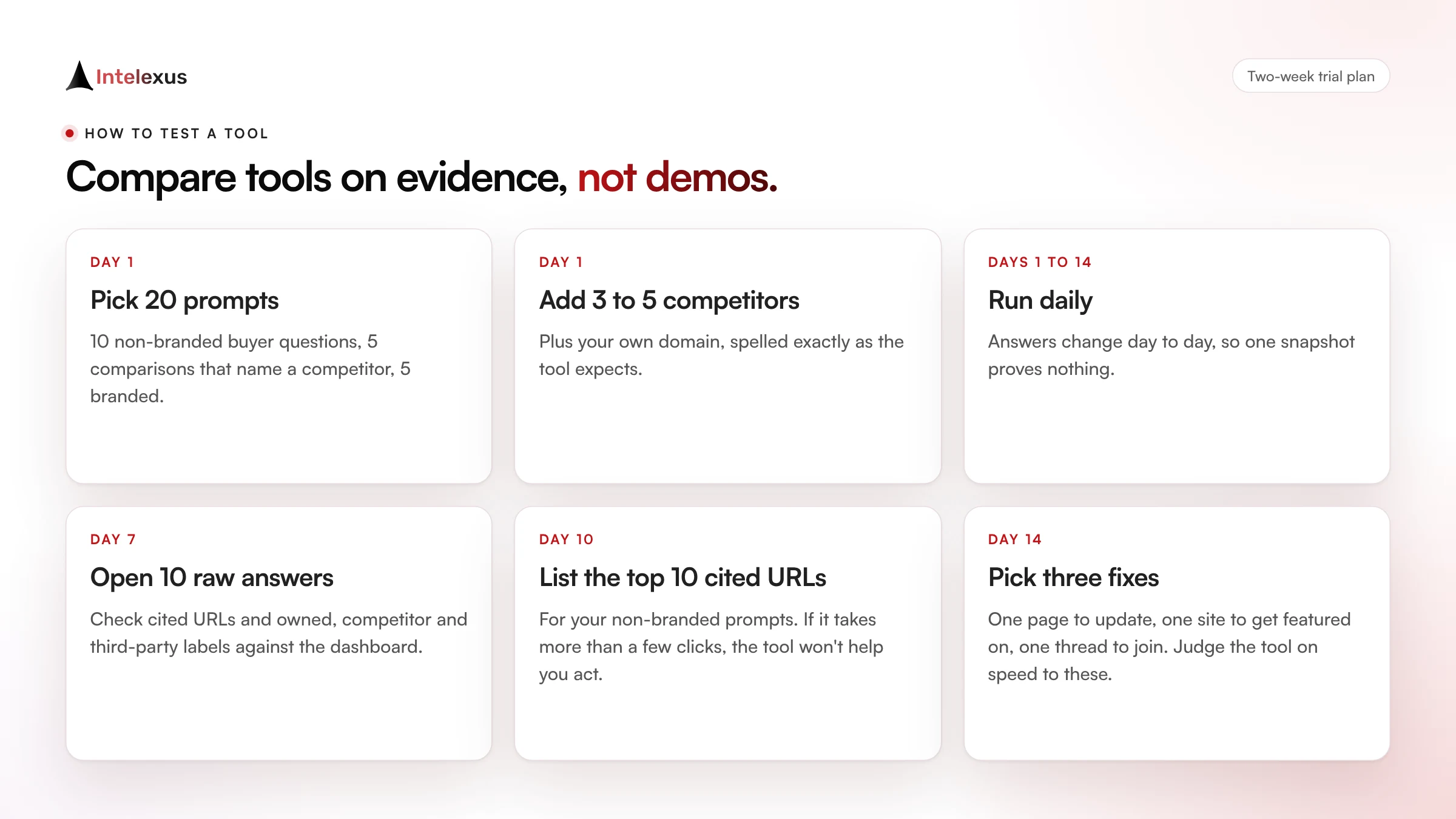
Most of these tools offer a trial or a low first month. Run the same test on your top two choices so you compare evidence, not demos.
Pick 20 prompts. Ten non-branded questions your buyers ask ("best X for Y"), five comparison prompts that name a competitor, and five branded prompts.
Add 3–5 real competitors and your own domain, spelled exactly as the tool expects.
Run daily for 14 days on the engines your buyers use; one snapshot is not enough because answers change day to day.
Open 10 raw answers and check them against the dashboard. Do the cited URLs match? Is each one labeled correctly as owned, competitor or third-party?
List the top 10 cited URLs for your non-branded prompts. If the tool can't give you that list in a few clicks, it won't help you act.
Pick three fixes from the data: one page to update, one third-party site to get featured on, one Reddit or community thread to join. Then judge each tool by how quickly it got you there.
FAQ
Which GEO tool is best for tracking citations and brand mentions?
If you want to act on citation gaps, not just see them, Intelexus is the strongest pick: it ties citations to buyer conversations and search data and ranks the fixes, from $49/month. For the deepest URL-level citation data, Promptwatch and Profound document the most detail. For the lowest cost, Otterly.AI starts at $29/month.
What is source attribution in AI search?
Source attribution means classifying every page an AI engine cites by who owns it: your site, a competitor, a review site, a news outlet, a forum or an institution. It shows which kinds of sources shape answers in your category.
Is there a platform that tracks brand citations across multiple AI engines?
Yes. All eight tools here track at least three engines, usually ChatGPT, Perplexity and a Google surface. AthenaHQ and Scrunch document up to eight engines; Peec AI lets you choose three per plan.
What is the difference between a mention and a citation?
A mention is your brand named in the answer text. A citation is a source link the engine shows beside its answer. You can be mentioned without being cited, and your pages can be cited in answers that recommend a competitor.
How often should citation data update?
Daily runs are the useful default, because AI answers vary from day to day. Judge trends over at least two weeks of repeated runs rather than a single day.
How do GEO platforms improve brand citations?
They don't change AI answers directly. They show which pages and sites get cited for your target prompts, so you can update your own pages, earn placements on the sites engines trust, and fix technical issues that stop AI crawlers reading your content.
Want to see which sources AI engines cite in your category? Start free and run your first project across ChatGPT, Perplexity and Gemini. Prefer a walkthrough first? Book a demo.